Thursday, April 26, 2012

In the News-Dave Coverly

Speed Bump Cartoonist Reflects on College, Art, and Life

Dave Coverly, author of the syndicated comic panel Speed Bump, will speak at the commencement of his alma mater, Eastern Michigan University, this weekend, Sunday, April 29, 2012. In an online article published today on the website of The Eastern Echo, Mr. Coverly offered a preview of his comments for the graduation ceremony to take place on the Ypsilanti campus. You can read the article by following this link. In case you're wondering what this could possibly have to do with Indiana: after graduating from Eastern Michigan, Dave Coverly went on to receive his master's degree from Indiana University and to work as a cartoonist for the Bloomington Herald-Times.

Copyright 2012, 2024 Terence E. Hanley

In the News-Abby Gross

University of Indianapolis Editorial Cartoonist Wins Award

Abby Gross, a cartoonist with the University of Indianapolis student newspaper The Reflector, has been awarded first place for her editorial cartooning in a recent competition sponsored by the Society of Professional Journalists Mark of Excellence Awards. The awards were for the society's Region 5, which includes colleges and universities in Indiana, Illinois, and Kentucky. The Reflector staff came away with ten individual and group awards all together. You can read more at the website of the University of Indianapolis News, or UIndy News, here. For a look at Ms. Gross' cartoons, see the opinion section of the online Reflector, here.

Copyright 2012, 2024 Terence E. Hanley

Friday, April 6, 2012

In the News-Dave Coverly

Cartoonist Dave Coverly To Speak at Commencement Ceremonies

Indiana University alumnus and cartoonist Dave Coverly, best known for his nationally syndicated comic strip Speed Bump, will be the commencement speaker at the graduation ceremonies of the Eastern Michigan University College of Arts and Sciences and the College of Technology on the morning of April 29, 2012. Mr. Coverly earned his bachelor’s degree in philosophy and imaginative writing from Eastern Michigan University in 1987 before going on to complete his master’s degree in creative writing at Indiana University in Bloomington. Mr. Coverly worked as an editorial cartoonist for the Herald-Times in Bloomington while attending graduate school, and his early cartoons appeared in The Saturday Evening Post, The New York Times, Esquire, and USA Today. In 1994, Speed Bump was picked up by Creators Syndicate. The panel quickly gained popularity, running in nearly 100 papers by 1995, at which time Coverly left the Herald-Times to concentrate on his daily cartoon panel. Today the feature appears in more than 200 newspapers and in Parade Magazine, which reaches more than 73 million readers each week. Mr. Coverly’s other accomplishments include a line of greeting cards for American Greetings and a number of books, including Sue McDonald Had a Book, Speed Bump: Cartoons for Idea People, and Caution Speed Bump: A Collection of Cartoon Skidmarks.

In addition to giving the commencement speech at the morning ceremonies on April 29, Mr. Coverly will be awarded an honorary Doctor of Fine Arts degree from his alma mater. You can read more in the following article:


Written by Bridget Hanley, Proficient Pen.
Copyright 2012 Terence E. Hanley

Tuesday, April 3, 2012

In the News-Ryan Germick

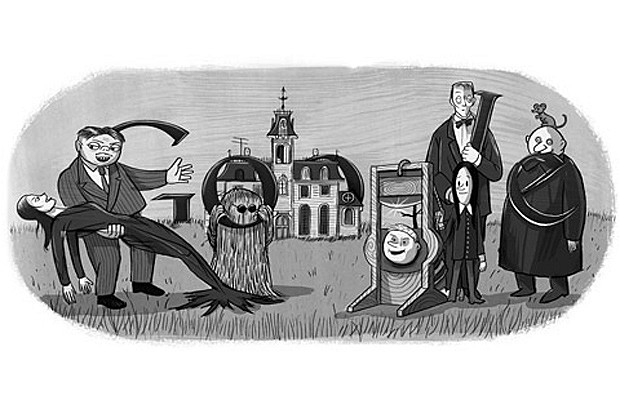
Merrillville Native Designs Addams Family Logo for Google

Merrillville native Ryan Germick recently created a logo for Google in which the members of the infamous Addams Family spell out the name of the world's most famous search engine. The altered logo appeared on the January 7, 2012, in honor of the 100th birthday of the late Charles Addams, creator of the eponymous family. Mr. Germick designed the logo after Google had secured permission by the estate of Charles Addams to re-create his characters. The Indiana artist was thrilled by the prospect of working on the project and coordinated his efforts closely with representatives from the estate, ensuring he did Addams’ work justice through his illustration. 

Ryan Germick has been a member of the Google Doodle Team since 2006. The team is the creative force behind special logos that appear on the Google search engine website on holidays and other special occasions. The Addams Family logo includes the major characters from Addams' long-running series of cartoons, which appeared in The New Yorker between 1938 and 1988, when Addams passed away. The Addams Family have also appeared in hardbound collections of cartoons, on television, in movies, and on stage. Addams never named his characters. The creators of the ABC-TV series gave them the names we know today, Gomez, Morticia, Uncle Fester, Lurch, and so on.

Mr. Germick, who graduated from Merrillville High School in 1998, received his early arts education in Merrillville and at the Center for Visual and Performing Arts in Munster, Indiana. (There's a small irony in the fact that a cartoonist who was educated in Munster has come to draw The Addams Family.) He went on to earn a liberal arts degree from Parsons Art School in New York and spent time in Tokyo, Japan, before joining the Google Doodle Team.

You can see the Google Addams Family logo by clicking here.

You can read a more detailed story, "Google This: Merrillville Man Has Dream Job as Search Website's 'Altered Logo' Illustrator," by Philip Potempa (March 15, 2012), at the website of the Northwest Indiana Times and Merrillville Community by clicking here.

Written by Bridget Hanley, Proficient Pen, and Terence E. Hanley.
Copyright 2012, 2024 Terence E. Hanley

Thursday, March 22, 2012

In the News-Nikko Elliott

Cartoon Controversy at Purdue University Calumet

A recent editorial cartoon by Nikko Elliott, appearing in the Purdue University Calumet Chronicle, has become part of a larger public discussion on the subjects of religious tolerance, racism, free speech, professor-student relations, and the point at which personal opinions, when expressed in a public forum, cross the line. If it sounds complicated, that’s because it is. To learn more about the issues inspiring the editorial cartoon and the larger controversy of which the cartoon has become a part, follow these links:

"PUC Professor Calls Cartoon Anti-Semitic" by Carmen McCollum, Northwest Indiana Times, March 8, 2012.

"Professor's Facebook Comments Draw Protests from Students" on NBC Chicago.

"PUC Students Protest Professor's Comments, Facebook Page” on Hammond Community.net.

Written by Bridget Hanley, Proficient Pen.
Copyright 2012, 2024 Terence E. Hanley

Wednesday, December 7, 2011

Hoosier Cartoonists in World War II

Seventy years ago today, on a date that will go on living in infamy, the Japanese navy launched a sneak attack on Pearl Harbor and the United States was thrust into world war. Within a few days, Nazi Germany declared war on the United States as well. After suffering early setbacks, the country gained its footing with an extraordinary victory at Midway (June 1942) and an invasion of North Africa (November 1942). After Pearl Harbor, young men rushed to enlist in the armed forces. Others were drafted. Figures vary, but by war's end upwards of 10 million American men and women had served in uniform. Over 400,000 were killed.

It's rare to find a man of military age who did not serve in one capacity or other. Hoosiers in uniform who had their cartooning careers interrupted by war or who went on to become cartoonists after the war included Wally Bishop (Muggs and Skeeter), Ted Chambers (gag cartoons), David C. Eastman (Carmichael), Bill Eddy (gag cartoons), Frank O'Neal (Short Ribs), and Bill Williams (Josephine). I would like to consider another group of cartoonists here, though, the men who cartooned while in uniform, for Yank, Stars and Stripes, All Hands, and other military magazines, newspapers, and newsletters.

Time was when cartoonists were celebrities and cartooning--especially syndicated cartooning and magazine gag cartooning--carried with it a heaping helping of prestige. Cartoonists entertained the troops, kept up morale, trained men in difficult and intricate tasks, and decorated airplanes with pinups and cartoon characters, among their many duties. One of the most famous of all folklore characters to come out of the war was a simple cartoon, a man with a bulbous nose who left his mark from Kiska to Bougainville to Marrakesh to Berlin: Kilroy Was Here! Another was the Gremlin, that mischievous little saboteur made famous by Roald Dahl and a planned movie by Disney that never reached the silver screen. A little less famous was Hubert, a lumpy dogface with an enormous nose and a talent for getting into trouble. Hubert, created by Herron art grad Dick Wingert (1919-1993), appeared in Stars and Stripes and was voted more popular than Bill Mauldin's Willie and Joe. After the war, Hubert returned to civilian life and lasted in the comics until 1994. What Wingert did for the army, Nicolas Pouletsos (1911?-1990)--"Nick Penn"--did for the navy in Stalemate. The title character is a diminutive, pop-eyed sailor always on the make. Nick Penn also drew Helen Highwater, featuring a shapely female, for all the men at sea.

Other Hoosier cartoonists in uniform included Wayne Campbell (Yank, Stars and Stripes), Ted Drake (The Spindrift), Charles K. Hall (Army Times, Yank), Roderick Hipskind (Beachhead News), Thomas G. Karsell (Stars and Stripes), Gilbert Sweeney (Stars and Stripes), and Pat Weishapl (The Returnee, Salty Breezes). Dave Gerard of Citizen Smith fame instructed navy men on technical drawing in his hometown of Crawfordsville during the war. In the immediate aftermath, husband-and-wife cartoonists Tom and Mary Blakley taught art to returning servicemen, while Indianapolis News staff artist J. Hugh O'Donnell--late of the 509th Military Police Battalion--illustrated Report from the Pacific by Leo Litz (1946). 

Indiana cartoonists had varying degrees of success in the postwar world. Dick Wingert, Nick Penn, and Ted Drake were among the men who stuck with cartooning. Most lived long, productive lives. But in thinking about the men who were young once and drew pictures during their wartime service, I can't help but consider those who didn't make it. What great future cartoonist or illustrator, artist or writer, lies buried under a green field in France or Italy or some other far-flung spot on the globe?


A cartoon by Ted Drake from The Spindrift.

Text and captions copyright 2011, 2024 Terence E. Hanley

Saturday, December 3, 2011

Almost a Hoosier

Stan Lee (1922-2018)

Half the world was at war in 1941 when nineteen-year-old Stan Lee assumed the position of editor at Timely Comics. Within a few months, the United States was involved as well, and Stan had enlisted in the U.S. Army Signal Corps. His basic training came at Fort Monmouth, New Jersey. In short order he was transferred to the Signal Corps' Training Film Division in Astoria, Queens, and found out that he had been classified as a playwright. "I also learned that there were only eight other men in the U.S. Army with that particular military occupational specialty (MOS) classification besides me," Stan writes in his autobiography. They included moviemaker Frank Capra, author William Saroyan, and cartoonist Charles Addams. During his tour of duty, Stan wrote scripts for army training films. He also continued penning stories for Timely Comics.

After a stop at Duke University, Stan Lee was transferred once again to Fort Benjamin Harrison, located northeast of Indianapolis. He would serve out the rest of his tour in the Hoosier State, advancing to the rank of sergeant, writing training materials, and even authoring the lyrics to a marching song for the Army Finance Department, sung to the music of "The Air Force Song." Fiscal Freddy, a cartoon character used to train fiscal officers, was one of Lee's creations. So was the poster design and slogan for a prophylaxis campaign: "VD? Not Me!"

"I was mustered out of the army in Indianapolis," Stan remembers. "Five minutes after receiving my discharge papers, I was in my convertible heading for New York." Thus ended his career as an army sergeant and a Hoosier. He married in 1947, wrote romance, western, horror, and other stories during the 1950s, and finally--with comic book artists Jack Kirby, Steve Ditko, and others--revolutionized comics during the 1960s. Stan Lee is still going strong today.

Update (December 6, 2019): And as we all know, Stan Lee died on November 12, 2018, in Los Angeles after a very long and illustrious career. He was ninety-five years old.

Excelsior! The Amazing Life of Stan Lee by Stan Lee and George Mair (2002), in which Stan remembers his time served in Indiana with the U.S. Army. The cover art is by John Romita, the mainstay on The Amazing Spider-Man after the departure of Steve Ditko.

Text and captions copyright 2011, 2024 Terence E. Hanley